.webp&w=96&q=75)
From AI Office
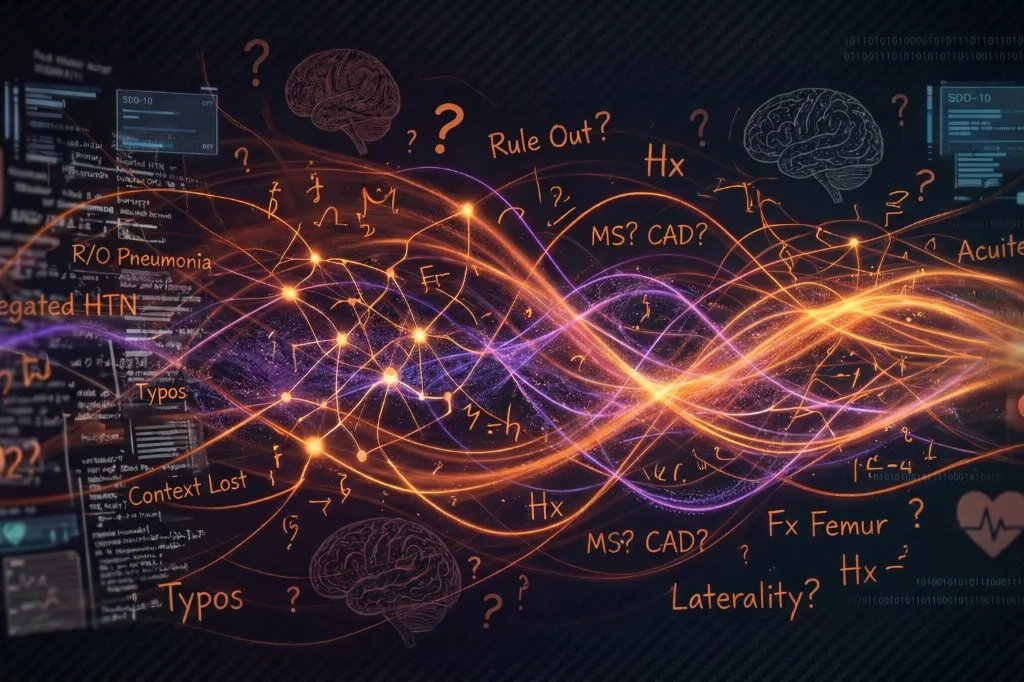
Clinical documentation was never designed for machines.
It is written under time pressure. It contains abbreviations, nested context, specialty-specific language, and temporal references layered across encounters. Yet much of today's automation in medical coding relies on probabilistic language interpretation.
Large Language Models (LLMs) such as ChatGPT and Google Gemini are remarkable at reading and summarizing text. But clinical coding is not a summarization task. It is a rule-bound validation task inside a regulated financial and compliance framework.
At Encipher Health, we believe the difference between prediction and validation is where reliability is either strengthened - or compromised.
After analyzing real-world clinical documentation at scale, twenty recurring phenomena consistently emerge where probabilistic systems struggle - and where structured reasoning changes the outcome.
Let's examine them.
Clinical notes are not flat text. They are structured ecosystems:
A probabilistic model interprets clinical notes as sequences of tokens, whereas a structural system interprets them as typed entities within constrained contextual containers- a distinction that ultimately determines performance in production environments.
"MS" may represent Multiple Sclerosis, Mitral Stenosis, or Morphine Sulfate. Frequency-based prediction cannot reliably resolve specialty-bound ambiguity. Encipher Health resolves meaning using section typing and contextual constraints before diagnostic construction.
"No evidence of pneumonia."
Negation must explicitly invalidate existence within the diagnostic set. We model it as a logical state, not a linguistic pattern.
"Father had CAD."
Family history cannot intersect with active diagnoses. Container separation prevents misassignment.
"History of stroke."
Temporal validation is required before instantiating an active condition.
"Rule out pulmonary embolism."
Unconfirmed conditions remain outside the billable state space until documented confirmation.
"Fracture of femur."
Without laterality, dimensional completeness is missing. Encipher enforces structural completion before code generation.
Acute vs chronic unspecified.
Instead of defaulting, our system flags incomplete dimensionality.
Resolved conditions may persist across encounters.
We evaluate temporal validity rather than repetition frequency.
"Patient on insulin."
Medication alone does not construct disease existence. Explicit diagnostic assertion is required.
"Post-op appendectomy."
Procedure does not imply active appendicitis. Context boundaries are preserved.
"Pneumonia vs CHF ."
Only confirmed diagnoses enter the validated coding set.
"DM2 uncontrolled."
Controlled ontology mapping resolves shorthand into validated constructs.
Overlapping terminology varies by discipline. Contextual container typing ensures correct semantic binding.
"CT shows mass."
Observation is separated from diagnostic assertion.
Elevated glucose does not equal diabetes. Observation and diagnosis exist in distinct structural layers.
"If symptoms persist, consider..."
Conditional states remain inactive until fulfillment criteria are met.
"Pneumonia resolved."
Active status must be explicitly validated prior to inclusion.
Severity or staging missing.
Encipher enforces dimensional completeness before code instantiation.
Token-based systems struggle with multilevel section boundaries. Encipher preserves hierarchy through structured topological containers.
"S/P MI."
Implicit shorthand requires explicit state construction - active, historical, or resolved - before validation.
Across all twenty phenomena, the pattern is consistent:
Probabilistic systems answer:
What is likely being said?
Encipher Health answers:
What is valid, confirmed, and constructible within regulatory constraints?
We design our platform around:
We do not treat coding as text prediction. We treat it as structured existence construction.
Healthcare organizations require systems that are:
Language models are powerful tools. But without structural governance, probability alone cannot meet enterprise-grade standards.
At Encipher Health, we are building the next generation of clinical intelligence - where AI does not guess what might be true, but validates what is provably correct.
Because "In healthcare, reliability is not optional,It is foundational."
Schedule a demowith Encipher Health and watch your charts move through a system built for verification.
Clinical notes contain abbreviations, negations, temporal references, and mixed contexts such as family history and active diagnoses, which are difficult for token-based models to interpret correctly.
Structural AI analyzes clinical information as typed entities within contextual containers, enabling validation of diagnoses based on context, time, and confirmation rules.
Healthcare systems require auditable, transparent, and regulation-compliant decisions, which deterministic reasoning provides by validating what is clinically and structurally supported.
Instead of guessing missing information, the system flags incomplete clinical dimensions such as missing laterality, severity, or acuity. This prevents premature or inaccurate code assignment.
AI Powered Medical Coding Intelligence





© 2026 Encipher Health Inc. All rights reserved.

1007 N Orange St. 4th Floor
Ste. 1382 Wilmington, New Castle,
DE- 19801

+1 (302) 353-1211
Don't Miss Out on Important News and Insights.